When your business partner stops pulling their weight but still owns half the company, you have one of the most common and destructive problems in small business: an ownership stake that no longer reflects who’s actually doing the work.
You didn’t notice it at first. Maybe they were dealing with something personal. Maybe business was slow and there wasn’t enough for two people to do. But weeks turned into months, and now you’re opening the shop, closing the shop, handling the clients, managing the books, and wondering why you’re splitting profits with someone who shows up when it’s convenient.
This isn’t a startup problem or a corporate problem. It’s a partnership problem, and by some estimates, as many as 70% of business partnerships fail because of it. Not because the business wasn’t viable. Because the people couldn’t work it out.
Here’s how to deal with it before it blows up.
Why this happens more than people admit
Nobody starts a partnership expecting to do all the work. But the drift is predictable.
Life changes. One partner has a kid, takes on a second job, or develops health issues. Their capacity shrinks but their ownership doesn’t. This isn’t malicious. It’s just life. But it still creates an imbalance.
Roles were never defined. You shook hands and said “we’ll figure it out.” Six months later, one person figured it out and the other didn’t. Without clear responsibilities, accountability is impossible.
The 50/50 default. Most partnerships start 50/50 because it feels fair. But equal ownership assumes equal contribution. The moment contributions diverge, 50/50 becomes the source of resentment, not fairness.
Conflict avoidance. You’re partners, maybe friends. Bringing up the imbalance feels like an accusation. So you don’t say anything. You absorb more work. You tell yourself it’s temporary. It rarely is.
No tracking mechanism. In a job, your boss sees what you do. In a partnership, there’s often no system for tracking who’s doing what. Without data, the conversation becomes “I feel like I’m doing more” vs. “I feel like I’m doing plenty.” Feelings don’t resolve disputes.
The real cost of doing nothing
Ignoring the imbalance doesn’t make it go away. It compounds. Our 2026 research found that equity disputes in small businesses are more severe than in startups, where investor pressure often forces resolution.
Resentment poisons everything
You start keeping a mental scorecard. Every time your partner takes a long lunch or leaves early, you notice. Every time you stay late, you notice. The resentment leaks into your communication, your decision-making, and eventually your customer experience. Partners who resent each other build worse businesses.
Your best people leave
If you have employees, they see the imbalance too. They watch you work 60-hour weeks while your partner works 20. They lose respect for the partnership, and eventually they lose motivation. Why should they work hard when one of the owners doesn’t?
The business hits a ceiling
A partnership where one person carries the load is functionally a solo operation with the overhead of a partnership. You can’t grow because you’re doing two jobs. You can’t hire because the profits are split with someone who isn’t earning their share. The business stagnates.
The exit becomes a nightmare
If you eventually want to sell the business or bring on new partners, the ownership imbalance creates problems. A buyer looks at your operating agreement and sees 50/50 ownership. Then they look at reality and see one person running everything. That’s a red flag. It signals governance risk, key-person dependency, and potential legal disputes.
The longer you wait to address an imbalanced partnership, the more expensive it becomes to fix.
How to have the conversation
This is the part everyone dreads. But avoiding it is what kills partnerships.
Start with data, not feelings
“I feel like I’m doing more” is easy to dismiss. “I’ve worked 240 hours this month and you’ve worked 60” is not. Before you have the conversation, spend two to four weeks tracking everything: hours, tasks completed, revenue generated, clients managed, problems solved. Write it down. Be specific.
Before you sit down with your partner, run the numbers through the partnership fairness calculator — it lets you model each person’s contributions across time, cash, and skills so you walk into the conversation with a concrete picture of the imbalance, not just a feeling.
If you’d been using a contribution tracking tool from the start, you’d already have this data. If you haven’t been tracking, start now. Even a shared spreadsheet works for the short term.
Choose the right setting
Not over text. Not during a crisis. Not at the end of a 14-hour day when you’re exhausted and angry. Schedule a dedicated conversation. Sit down face to face. Frame it as a business discussion, not a personal attack.
Lead with the problem, not the blame
Don’t say: “You’re not doing your share and it’s not fair.”
Say: “Our contributions have gotten out of balance, and I want to talk about how we fix it. Here’s what I’ve been tracking.”
The first version triggers defensiveness. The second invites problem-solving.
Present options, not ultimatums
Your partner is more likely to engage productively if they have choices:
- Recommit. They increase their hours and take on specific, measurable responsibilities with a timeline to evaluate.
- Restructure. You adjust the ownership split or profit sharing to reflect actual contributions going forward.
- Step back. They reduce their ownership stake and take a less active role, either as a silent partner or through a planned buyout.
- Part ways. One partner buys the other out, or you dissolve the partnership.
Set a follow-up date
Don’t let the conversation end with vague commitments. “I’ll do better” isn’t a plan. Agree on specific actions, measurable outcomes, and a date (30-60 days out) to reconvene and evaluate whether things have actually changed.
Restructuring the ownership split
If your partner acknowledges the imbalance and is willing to restructure, you have several options depending on your business entity.
Important: any change to ownership percentages should be reviewed by both a business attorney and a tax advisor. Restructuring ownership in an LLC or partnership can trigger taxable events under IRC Section 704(b), and the IRS may treat a reallocation as a gift, sale, or compensation depending on how it’s structured. Capital accounts need to be rebalanced. Getting this wrong creates unexpected tax bills for both partners.
Adjust the operating agreement
For an LLC, ownership percentages and profit-sharing arrangements are defined in the operating agreement. Amending it requires consent from all members (unless the agreement specifies otherwise). You can change the ownership split, adjust profit distributions, or create a tiered structure where active partners earn a management fee before profits are split.
Move to contribution-based ownership
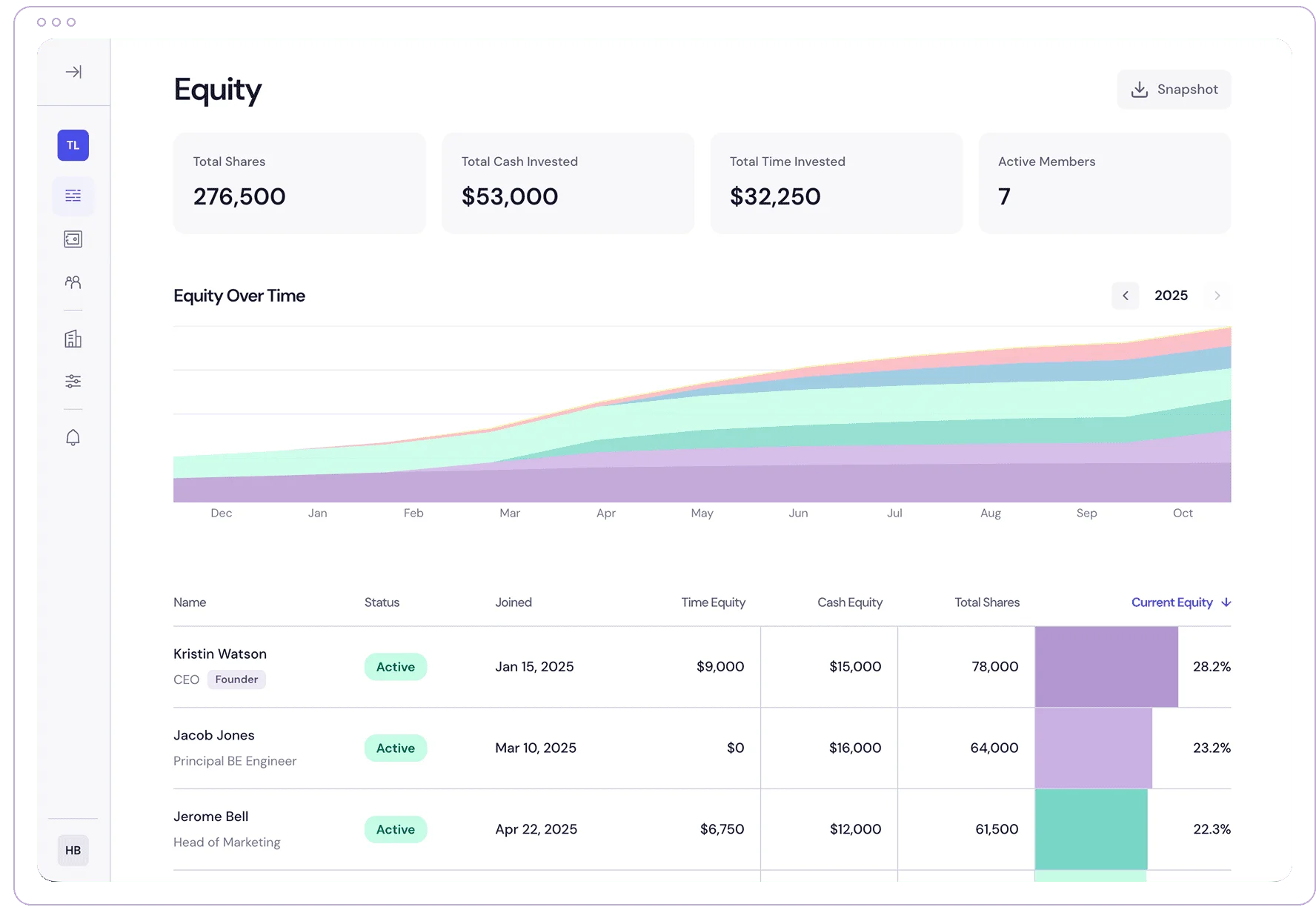
Instead of a fixed split, you can adopt a model where ownership reflects ongoing contributions. This is what dynamic equity does. Each partner’s ownership percentage adjusts over time based on what they actually put in: hours worked, cash invested, clients brought in, skills contributed.
This approach eliminates the “not pulling their weight” problem structurally. If someone contributes less, their ownership percentage naturally decreases. If they step up, it increases. No arguments. No guesswork. Just math.
Tools like Equity Matrix automate this tracking. You define what counts as a contribution, log it weekly, and the ownership percentages update automatically. When it’s time to distribute profits, the split reflects reality.
One caveat: contribution tracking is a management tool, not a legal instrument on its own. For any ownership changes to be enforceable, they need to be reflected in a formally amended operating agreement. The tracking data supports and informs the legal changes but doesn’t replace them.
Create a vesting schedule
If your partner agrees to earn back into their ownership stake, you can set up a vesting arrangement. They keep their current percentage, but a portion of it vests over time based on continued contribution. If they stop contributing again, the unvested portion returns to the active partner.
This is standard practice in the startup world (vesting schedules explained), and the same concept can be adapted for small business partnerships. The legal mechanics are different from startup equity vesting (LLC forfeiture provisions require careful drafting and have different tax treatment), so you’ll need an attorney to set this up correctly. But the principle is the same: ownership reflects ongoing contribution, not a one-time handshake.
When to bring in a mediator
Some conversations are too charged for the two of you to handle alone. That’s not a failure. It’s a recognition that the stakes are high and emotions are involved.
Consider a mediator when:
- Previous conversations have ended in shouting, silence, or nothing changing
- The imbalance has been going on for more than six months
- There’s a significant financial dispute (profit distributions, unpaid loans, contested expenses)
- One partner is threatening legal action
- The partnership involves family members
A business mediator (not a therapist, not a friend) can structure the conversation, keep it productive, and help you reach an agreement that both sides can live with. Mediation typically runs $3,000-$10,000 for a partnership dispute across several sessions. Compare that to partnership litigation, which commonly reaches six figures once attorneys, discovery, and court time are factored in.
When to walk away
Not every partnership is worth saving. If you’ve had the conversation, given it time, and nothing has changed, you’re left with two options.
Buy them out
You purchase your partner’s ownership stake at an agreed-upon valuation. This gives you full control of the business and eliminates the drag on decision-making and morale. The hard part is agreeing on the price. A formal business valuation helps. So does a buy-sell agreement if you had one from the start (these require an attorney to draft properly — the SBA overview is a starting point, not a template).
If you’re wondering how to value the business, revenue multiples vary by business type: service businesses typically sell for 0.5-1.5x revenue, while businesses with recurring revenue or strong brand value command higher multiples.
Dissolve the partnership
If neither partner wants to buy the other out, you can dissolve the business. This is the nuclear option. It requires a formal winding-up process: notifying creditors, filing dissolution paperwork with the state, liquidating assets, paying debts, and splitting whatever remains according to the operating agreement (or state defaults if there isn’t one). Dissolution typically requires legal counsel and can take months, especially if the partners disagree on asset valuations, client ownership, or ongoing obligations.
Before you dissolve, seriously consider whether a buyout is feasible. Even at a price that feels too high, buying out a non-contributing partner is almost always cheaper than shutting down a functioning business.
How to prevent this from happening in the first place
If you’re reading this before the problem starts (or starting a new partnership after a bad one), here’s how to protect yourself.
Write an operating agreement
If you don’t have a written partnership agreement, get one. It should define: ownership percentages, profit-sharing arrangements, roles and responsibilities, decision-making authority, what happens if someone stops contributing, buyout provisions, and dissolution procedures. A handshake is not a legal document.
Define roles explicitly
Who does what? Write it down. Not “we both do sales” but “Alex handles inbound leads and client relationships. Jordan manages operations, billing, and vendor relationships.” Clear roles create clear accountability.
Track contributions from day one
You don’t need a complex system. You need a consistent one. Log hours weekly. Track cash investments. Record who brought in which client. When contributions are visible, imbalances get addressed early instead of festering. Equity Matrix does this automatically, or you can start with a shared spreadsheet.
Schedule regular check-ins
Quarterly sit-downs where you review contributions, discuss the health of the partnership, and address any drift before it becomes a crisis. Think of it as preventive maintenance. The equity review matrix framework can structure these conversations.
Include a contribution clause in your agreement
Your operating agreement should specify what happens when a partner’s contributions fall below an agreed-upon level. Options include: mandatory mediation, ownership adjustment triggers, right to initiate a buyout, or a defined process for removing a non-contributing member. Having this in writing before it’s needed removes the emotion from the conversation.
Frequently asked questions
Can I force my business partner to work harder?
No. You can’t force anyone to contribute more to a business. What you can do is tie their ownership or profit share to their contribution level, restructure the agreement to reflect actual work, or initiate a buyout if the imbalance can’t be resolved. The operating agreement governs what’s possible. If you don’t have one, state default rules apply, and those rarely favor the active partner.
What if we don’t have a written operating agreement?
Without a written agreement, your state’s default partnership or LLC rules apply. Default rules vary by state and entity type, but they rarely account for differences in ongoing effort. For general partnerships, most states default to equal profit sharing regardless of capital contributions. For LLCs, defaults vary more widely. This makes it significantly harder (and more expensive) to restructure. Get a written agreement as soon as possible, even if you’re already in a dispute. An attorney can help you formalize terms that both partners agree to.
How do I value my partner’s share for a buyout?
Start with the business’s fair market value using appropriate valuation methods for your business type. For a step-by-step breakdown of the process, including whether to hire an appraiser, how to handle a seller-financed deal, and what documents you’ll need, see the partner buyout guide. Apply their ownership percentage. Then negotiate. If you can’t agree, hire an independent business appraiser (typically $2,000-$10,000 depending on complexity). Some operating agreements include a pre-agreed valuation formula, which avoids this negotiation entirely.
Is it too late to start tracking contributions?
No. Starting now gives you data going forward, which is better than relying on memory for past contributions. Even a few months of tracked data creates a foundation for a productive conversation about restructuring. The longer you track, the more defensible the data becomes.
Stop guessing who’s doing what. Use the partnership fairness calculator to model where your split stands today, then start tracking contributions with Equity Matrix so it stays fair as the business grows.
Ready to split equity fairly?
Equity Matrix tracks contributions and calculates ownership automatically.
Get Started FreeThis article is for informational purposes only and does not constitute legal, tax, or financial advice. Equity Matrix is not a law firm, accounting firm, or financial advisor. Consult a qualified professional for guidance specific to your situation.

Co-founder, Equity Matrix
Sebastian writes about startup equity, founder dynamics, and building fair partnerships.
Keep reading
How to fire a co-founder (and what happens to their equity)
Firing a co-founder is legally and emotionally brutal, and the equity is the part that haunts you. Here's how to do it right, what vesting and cliffs actually protect, and how to avoid leaving a dead stake on your cap table.
Read more →How to buy out a business partner: a complete guide
A practical guide to buying out your business partner, from valuing the business to structuring the deal and avoiding costly mistakes.
Read more →