Firing a co-founder means ending their operational role, but their equity doesn’t leave with them unless you planned for it. Whatever they’ve vested, they keep. That’s why the outcome is decided long before the conversation, in the vesting schedule and cliff you set up on day one.
Nobody starts a company planning to fire the person they started it with.
But it happens more than founders admit. One study of startups found that co-founder conflict is one of the leading reasons early companies fall apart, ahead of running out of money in some analyses. The person you trusted enough to build something with becomes the person you have to remove.
And the hardest part usually isn’t the conversation. It’s the equity.
Someone can walk out of the building and never write another line of code for you, and still own 30% of your company on the way out. If you didn’t set things up carefully, that stake follows you into every future fundraise, every acquisition conversation, every hard year where you’re doing all the work and they’re doing none.
Let me walk through how to handle this without making it worse.
Before anything else: is firing actually the answer?
Removing a co-founder is one of the most destructive things you can do to a company, so it’s worth being honest about whether you’re there yet.
Some situations genuinely call for it: someone who’s checked out, someone whose behavior is damaging the company or the team, an unfixable disagreement about direction that’s paralyzing every decision. If a co-founder has stopped contributing entirely, the company suffers whether you act or not.
But plenty of conflict is fixable. Founders fight because the stakes are high and the pressure is relentless. That’s normal. Before you reach for the nuclear option, it’s worth asking whether the real problem is the person or the situation, and whether a hard conversation or a change in roles could fix it.
If you’ve genuinely worked through that and the answer is still yes, keep reading.
Firing a co-founder is rarely a surprise to anyone involved. By the time you’re seriously considering it, they usually know something is wrong too.
The equity is decided before the conversation, not during it
Here’s the thing most first-time founders get wrong: you don’t get to decide what happens to a co-founder’s equity when you fire them. You decided that when you set up the equity in the first place.
If you gave your co-founder a big chunk of stock with no vesting, they own it. You can remove them from the company, change the locks, and cut off their email, and they’ll still hold that entire stake. There’s very little you can do after the fact.
This is why vesting exists, and why skipping it is one of the most expensive mistakes a founder can make.
What vesting actually protects
Vesting means equity is earned over time rather than owned outright from day one. The standard structure looks like this:
| Element | Standard | What it does |
|---|---|---|
| Total schedule | 4 years | Equity earned gradually over four years |
| Cliff | 1 year | Nothing vests until the 1-year mark, then a lump vests at once |
| Frequency after cliff | Monthly | Remaining shares vest in monthly increments |
So if you fire a co-founder who’s been around 18 months on a standard four-year schedule, they keep roughly 37.5% of their promised stake. The rest, the shares that haven’t vested yet, return to the company.
If you fire them at 10 months, before the cliff, they typically walk away with nothing. That’s exactly what the cliff is for: it protects the company from someone who leaves or gets removed early.
Vesting schedules explained: cliffs, graded, and 4-year plans
What “what they keep” really means
Say your co-founder had 40% of the company on a four-year vest, and you part ways at the two-year mark.
- They keep the vested half: roughly 20% of the company.
- The unvested half, another 20%, returns to the pool.
- That 20% they keep is theirs forever, whether or not they ever contribute again.
That vested 20% is now dead equity: a live ownership stake held by someone doing none of the work. It doesn’t disappear. It sits on your cap table, it dilutes everyone still building, and investors will ask about it in every future round.
There’s nothing dishonorable about a departing co-founder keeping what they earned. Two years of real work should be worth something, and it is. The problem is only when the split was never tied to contribution in the first place, so the “earned” stake has no relationship to what they actually did.
How to actually have the conversation
The equity math is the cold part. The conversation is the human part, and it deserves more care than most founders give it.
A few things I’ve noticed separate the ones that go okay from the ones that go badly:
The ones that go worst happen over Slack. This person took a risk on your company. The departures people still resent years later are almost always the ones delivered through a lawyer’s letter or a message, not face to face.
The founders who relitigate everything make it worse. You don’t need to win the argument. You need to be clear that the decision is made. Endless debate about who was right just prolongs the pain for both of you.
The chaotic conversations are the ones where nobody knew the numbers. Walk in knowing exactly what they’ve vested, what returns to the company, and what any co-founder agreement says about buybacks or repurchase rights. Uncertainty about the equity picture turns a hard conversation into a messy one.
Handshake understandings become disputes. Whatever you agree on, get it into a clean separation agreement reviewed by a lawyer. Verbal understandings about equity have a way of drifting later.
How you handle the exit outlives the exit. The startup world is small, and word travels. The way a founder treats a departing co-founder says more about them than almost anything else they do.
The mistake that makes all of this worse
Almost every painful co-founder firing traces back to the same root cause: the equity was split by guessing, up front, before anyone knew how things would actually play out.
Two people shake hands on 50/50 in a coffee shop. One of them turns out to carry the company. The other fades. But the split doesn’t move, because it was carved into the cap table on day one. Now the only way to correct it is the brutal, adversarial process of firing someone and clawing back unvested shares.
Vesting softens this, and you should absolutely use it. But vesting still assumes the original split was right. It just releases a guess slowly instead of all at once.
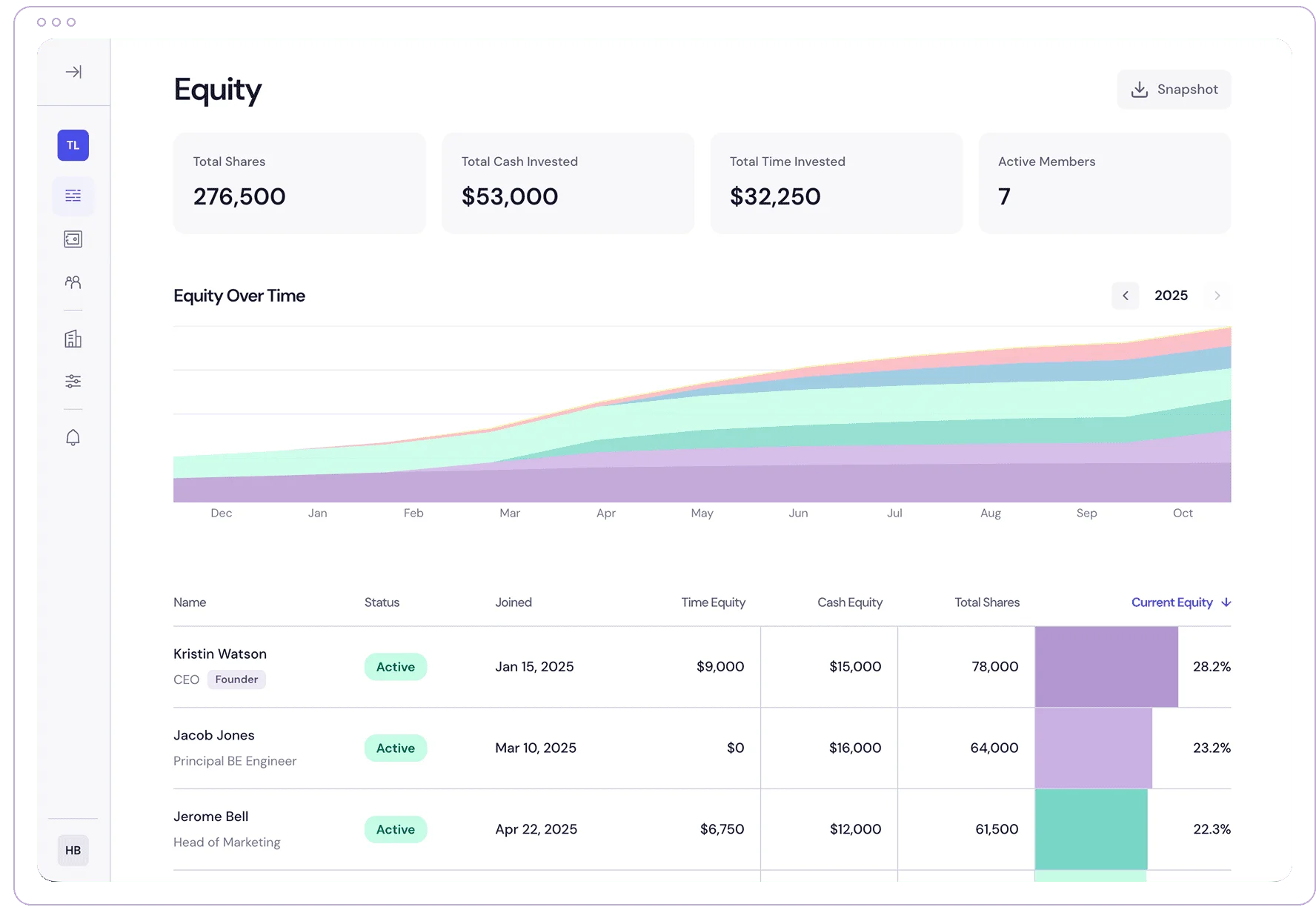
The deeper fix is to stop guessing. With dynamic equity, ownership tracks what each person actually contributes over time. If a co-founder stops showing up, their share stops growing, on its own, without a confrontation. It won’t make every hard conversation disappear, but far fewer of them will start with someone owning a third of the company for work they stopped doing a year ago.
Frequently asked questions
Can you take a co-founder’s equity when you fire them?
Only the portion that hasn’t vested. Whatever a co-founder has already vested is legally theirs, and firing them doesn’t change that. Unvested shares typically return to the company. If there was no vesting at all, they keep their entire stake, which is why vesting is essential from day one.
What happens to unvested shares when a co-founder leaves?
They generally return to the company’s equity pool, where they can be reallocated or absorbed by the remaining owners. This is the main protection vesting provides: it makes sure someone who leaves early only walks away with the portion they actually earned.
What is a cliff and why does it matter when firing a co-founder?
A cliff is a period, usually one year, during which no equity vests. If a co-founder is removed before the cliff, they typically get nothing. It exists precisely to protect the company from someone who leaves or is removed in the first year, before they’ve contributed enough to earn any ownership.
How do I avoid dead equity from a departed co-founder?
Two things. First, always use vesting with a cliff, so an early departure returns unvested shares. Second, tie ownership to contribution rather than a fixed up-front guess. Dynamic equity does this automatically, so a co-founder who stops contributing stops accumulating ownership, which prevents most dead equity before it forms.
Should I use a lawyer when firing a co-founder?
Yes. Even an amicable separation should be documented in a written agreement reviewed by counsel, covering equity treatment, any repurchase rights, confidentiality, and a clean release. The cost is small compared to the cost of a disputed departure later.
The best time to prepare for a co-founder departure is before you ever need to. Our equity calculator helps you structure a split that reflects real contribution, so an exit stays clean instead of leaving a dead stake on your cap table.
Ready to split equity fairly?
Equity Matrix tracks contributions and calculates ownership automatically.
Get Started FreeThis article is for informational purposes only and does not constitute legal, tax, or financial advice. Equity Matrix is not a law firm, accounting firm, or financial advisor. Consult a qualified professional for guidance specific to your situation.

Co-founder, Equity Matrix
Sebastian writes about startup equity, founder dynamics, and building fair partnerships.
Keep reading
How to buy out a business partner: a complete guide
A practical guide to buying out your business partner, from valuing the business to structuring the deal and avoiding costly mistakes.
Read more →My business partner isn't pulling their weight
When one partner does all the work while the other collects half the profits, resentment builds fast. Here's how to address it before the partnership implodes.
Read more →