If you and your partner never wrote down how you split profits, the law has already decided for you: an equal split, no matter who put in what. One partner can contribute $90,000 and the other $10,000, and they still split 50/50.
That default is the reason this post exists. Most partnership fights over money aren’t caused by greed — they’re caused by two people who each assumed the split would work out “fairly” and never defined what fair meant. So before we get to methods, understand the rule you’re up against.
The default rule that bites: no agreement means equal shares
In nearly every US state, a general partnership with no written agreement defaults to equal profit sharing regardless of contribution. This comes from the Uniform Partnership Act and its revision (RUPA), which most states have adopted. RUPA gives each partner an equal share of profits unless the partners agree otherwise, and losses simply follow profits.
So the partner who bankrolled most of the business and the one who barely chipped in still split the profits down the middle. If that sounds unfair, it is, which is exactly why you write it down. A written agreement is the only thing standing between you and a default that ignores everything you actually contributed.
The methods for splitting when contributions differ
Once you decide to define the split yourself, there are a handful of standard approaches. Most real partnerships blend them.
- Equal split. Simple and clean when contributions really are roughly equal. It breeds resentment fast when they aren’t.
- Capital-proportional. Profits track how much cash each partner put in. Fair when the business is mostly funded by money, less so when one partner’s main contribution is labor.
- Contribution-weighted. The most flexible: blend cash, time, expertise, and relationships (like brought-in clients) into a single weighting. This is the approach that actually handles “one of us funds it, the other runs it.”
- Salary-then-split. Pay the working partner a fixed amount first for their labor, then split whatever profit remains. Keeps the labor contribution from being invisible.
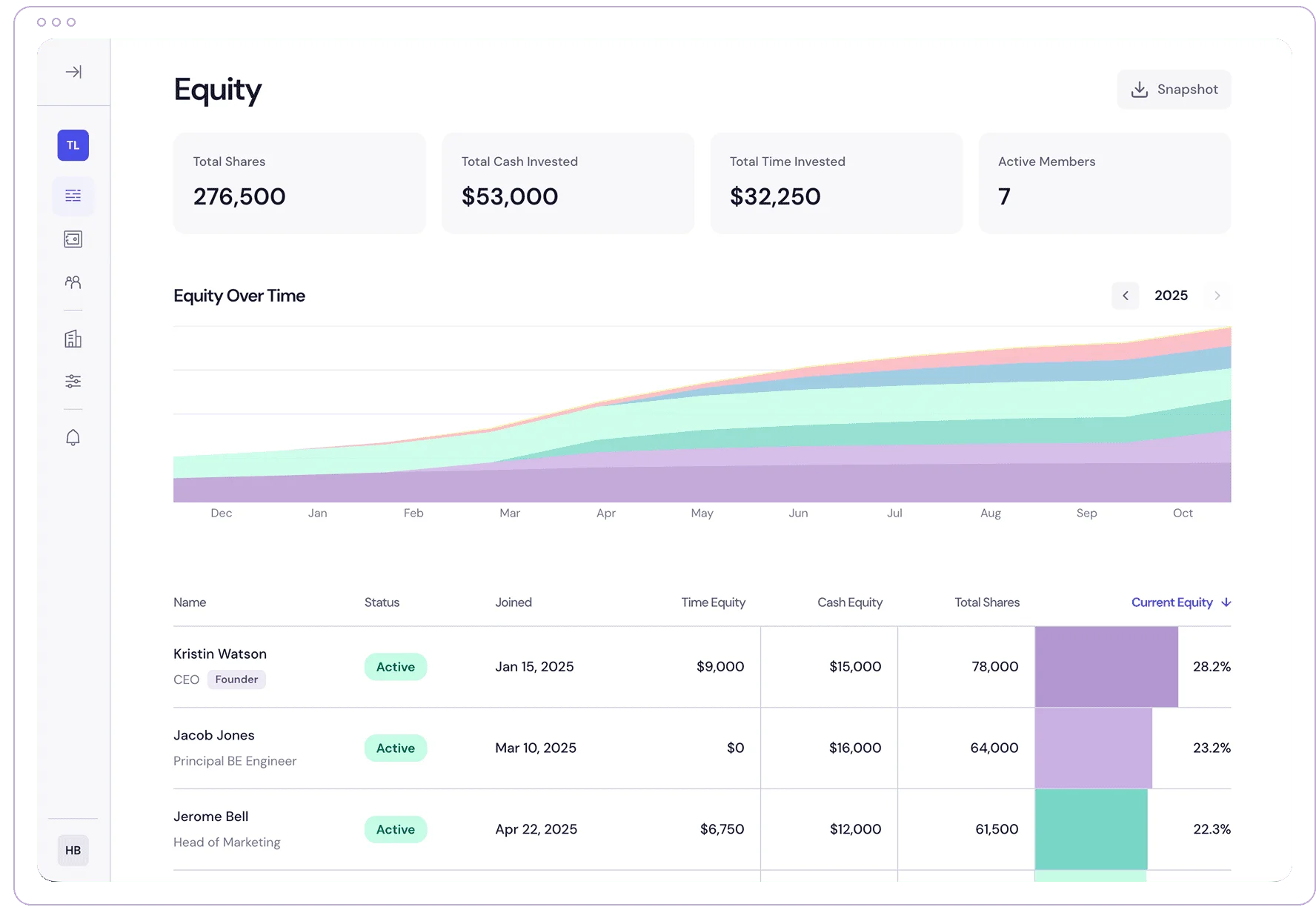
The contribution-weighted approach is usually the honest one when partners bring different things, and it’s the model our partnership calculator is built around. You enter what each partner puts in and see the split it implies.
In an LLC, the profit split can differ from ownership
Here’s a point that surprises a lot of small-business owners: your profit split does not have to match your ownership percentages.
An LLC operating agreement can use a special allocation to divide profits in a way that doesn’t track ownership. Two 50/50 owners can agree that one takes 70% of profits in the early years to reflect a bigger initial investment or a heavier day-to-day role, then rebalance later.
One catch worth knowing: the IRS only respects a special allocation if it has “substantial economic effect” — meaning it genuinely changes the partners’ economic outcomes, not just their tax bills. If the allocation looks like paper tax-shifting, the IRS reallocates income by ownership percentage regardless of what your agreement says. This is a place to involve an accountant rather than freelance it.
How to value the non-cash contributions
The whole problem with unequal contributions is that money is easy to count and everything else isn’t. To weight time and expertise fairly, you have to put a number on them. There are three defensible ways:
- Replacement cost: what it would cost to hire someone to do the working partner’s job.
- Market rate × hours: a fair hourly rate for the skill, times hours worked.
- Opportunity cost: what the working partner gave up by doing this instead of a comparable job. This is often the most defensible number.
We go deep on this in our guide to valuing sweat equity when there’s no cash. The short version: anchor the hourly rate to real market data rather than a number you like, and count total compensation for the role, not just base salary.
Don’t forget the tax mechanics
Two things about partnership taxes shape how you should structure the split.
Partnerships are pass-through. The partnership itself pays no income tax. It files Form 1065 and issues each partner a Schedule K-1 reporting their share of profit. Each partner then pays tax on that share on their personal return.
You’re taxed on your allocation, not your distribution. This is the one that catches people. If your agreement allocates you $75,000 of profit but you only actually took $25,000 out of the business, you owe tax on the full $75,000. That gap is exactly why the split has to be written down and understood by everyone: the K-1 allocation drives each partner’s tax bill whether or not the cash followed.
If the working partner is paid a fixed amount for their labor before the split, that’s usually a guaranteed payment under IRC Section 707(c) — deductible by the partnership, taxable to the partner, and paid whether the business profits or not. Worth noting: guaranteed payments are self-employment income, so they carry Social Security and Medicare tax on top of income tax.
Write it down before you need it
Disputes over capital contributions and profit distribution are among the most common ways partnerships fall apart — usually when the partner who put in more expected more, and the other expected an even split, and nobody ever said so out loud. A written agreement that states each partner’s profit share, and addresses losses, overhead, and any salaries, is the standard prevention.
The best time to have that conversation is when everyone is optimistic and nobody’s owed anything yet. Model a few splits with the partnership calculator, agree on the logic, and put it in writing while it’s still easy.
Frequently asked questions
How do you split profits in a partnership fairly?
Decide on a method and write it down. When contributions are unequal, a contribution-weighted split (blending cash, time, and expertise) is usually the fairest. Whatever you choose, define it in a written agreement — otherwise the legal default of an equal split applies regardless of contribution.
What happens if partners don’t have a written agreement?
In most US states, the default under the Uniform Partnership Act is an equal split of profits regardless of how much each partner contributed. So the partner who invested far more still splits 50/50 unless a written agreement says otherwise.
Can profit split be different from ownership percentage in an LLC?
Yes. An LLC operating agreement can use a special allocation to split profits differently from ownership percentages, as long as the allocation has substantial economic effect. If it doesn’t, the IRS reallocates by ownership percentage.
Are partners taxed on money they didn’t take out of the business?
Yes. Partners are taxed on their allocated share of profit, not on what they actually distributed to themselves. If you’re allocated $75,000 but only drew $25,000, you still owe tax on the full $75,000.
Ready to split equity fairly?
Equity Matrix tracks contributions and calculates ownership automatically.
Get Started FreeThis article is for informational purposes only and does not constitute legal, tax, or financial advice. Equity Matrix is not a law firm, accounting firm, or financial advisor. Consult a qualified professional for guidance specific to your situation.

Co-founder, Equity Matrix
Sebastian writes about startup equity, founder dynamics, and building fair partnerships.
Keep reading
Equity for small businesses: partnerships and LLCs
Equity isn't just a startup problem. Here's how partnerships, LLCs, and S-corps handle ownership — and which structure protects you when contributions aren't equal.
Read more →Does your small business need an equity agreement?
Most small businesses start with a handshake and figure out equity later. By the time they realize they need an agreement, the damage is already done. Here's why you need one now.
Read more →