Liechtenstein at a glance
Default split
Proportional to capital
Startup entity
Gesellschaft mit beschränkter Haftung (GmbH)
Minimum capital
CHF 10,000 (~€10,500)
Community property
No
Formation cost
CHF 3,000–7,000
Key legislation
Personen- und Gesellschaftsrecht (PGR)
Liechtenstein is a microstate between Switzerland and Austria with about 39,000 inhabitants. Despite its small size, it has a sophisticated legal framework. The PGR (Persons and Companies Act) is uniquely flexible, offering entity forms not available elsewhere, including the Anstalt (establishment) and Stiftung (foundation) used for asset protection. The corporate tax rate is 12.5%. Liechtenstein uses the Swiss franc and has a customs union with Switzerland. It is an EEA member but not in the EU.
Default partnership rules in Liechtenstein
Under Liechtenstein's PGR, a Kollektivgesellschaft (general partnership) distributes profits based on the partnership agreement. Without one, profits are shared proportionally to contributions, with each partner receiving 4% interest on their capital first, then the remainder split equally (similar to German/Austrian rules). Partners are jointly and severally liable.
In Liechtenstein, profits are split proportionally to capital contributions by default. This means a partner who invested 80% of the capital would receive 80% of the profits. While this may seem more intuitive than the equal-split default in some countries, it still fails to account for non-cash contributions like time, expertise, and relationships. A written partnership agreement should address all types of contributions.
Gesellschaft mit beschränkter Haftung (GmbH) in Liechtenstein
The GmbH is the standard entity for Liechtenstein businesses. Minimum share capital is CHF 10,000, fully paid at incorporation. Formation requires a notarial deed and registration with the Handelsregister (Commercial Register). Total costs range from CHF 3,000 to CHF 7,000. Liechtenstein's PGR offers unique entity forms including the Anstalt and Stiftung, but the GmbH remains the most common for operating businesses. Share transfers require written form.
Without a shareholders' agreement, the relationship between founders is governed by the country's default rules, which rarely account for the realities of a startup — where contributions change over time and early effort often goes uncompensated. An operating agreement or shareholders' agreement is essential. Use our equity calculator to determine a fair split based on actual contributions, or our partnership calculator if you're splitting profits between partners.
What happens when a partner leaves in Liechtenstein
In a Kollektivgesellschaft, a partner can withdraw with six months' notice. For GmbH companies, share transfers require written form and may require shareholder approval depending on the articles. The PGR provides for dissolution on just grounds.
A written agreement should address departure terms specifically, including how the buyout value is calculated, the payment timeline, vesting schedules, and any non-compete provisions. Understanding the concept of dead equity is important for managing these situations. Learn more about how dead equity affects businesses.
Marriage and business equity in Liechtenstein
Liechtenstein uses separate property (Gütertrennung) as the default matrimonial regime. Each spouse retains ownership of their own assets during the marriage. On divorce, only specific categories of assets may be subject to equalization. Business assets generally remain with the owning spouse. A marriage contract (Ehevertrag) can modify the regime.
Liechtenstein uses separate property (Gütertrennung) as the default matrimonial regime. While Liechtenstein's separate property regime is generally more favorable for business owners, a clear equity agreement and proper documentation of ownership remain important for protecting your interests.
Formation and cost details
| Main startup entity | Gesellschaft mit beschränkter Haftung (GmbH) |
| Minimum capital | CHF 10,000 (~€10,500) |
| Formation cost | CHF 3,000–7,000 |
| Default equity split | Proportional to share capital contributions |
| Default partnership split | Proportional to capital contribution |
| Community property | No |
| Key legislation | Personen- und Gesellschaftsrecht (PGR) |
Frequently asked questions
What is the minimum capital for a Liechtenstein GmbH?
The minimum share capital is CHF 10,000 (approximately €10,500), fully paid at incorporation. Formation requires a notarial deed and costs CHF 3,000–7,000.
What is Liechtenstein's corporate tax rate?
The corporate tax rate is 12.5%. There is no capital gains tax for companies. Liechtenstein has an extensive network of double taxation agreements.
Is Liechtenstein in the EU?
No. Liechtenstein is not in the EU but is an EEA member. It uses the Swiss franc and has a customs union with Switzerland. EEA membership provides access to the EU single market.
How does divorce affect business ownership in Liechtenstein?
Liechtenstein uses separate property by default. Business assets generally remain with the owning spouse on divorce. This makes it one of the most business-owner-friendly jurisdictions in Europe for matrimonial property.
Related resources
- Equity calculator: find a fair split for your business
- Partnership calculator: split profits fairly between partners
- Does your small business need an equity agreement?
- Equity for small businesses: the complete guide
- Dead equity calculator: how much is yours costing you?
- Slicing Pie calculator
- What is an operating agreement?
- All 32 European countries: partnership and formation laws
- US state directory: partnership and LLC default rules
Partnership laws in neighboring countries
Disclaimer: This page provides general information about Liechtenstein partnership and business formation laws and is not legal advice. Laws change, and the information here may not reflect the most recent amendments. The formation costs and capital requirements listed are approximate and may vary. Consult a qualified attorney licensed in Liechtenstein for advice specific to your situation. Equity Matrix is a software tool for tracking contributions and calculating equity; it does not provide legal services.
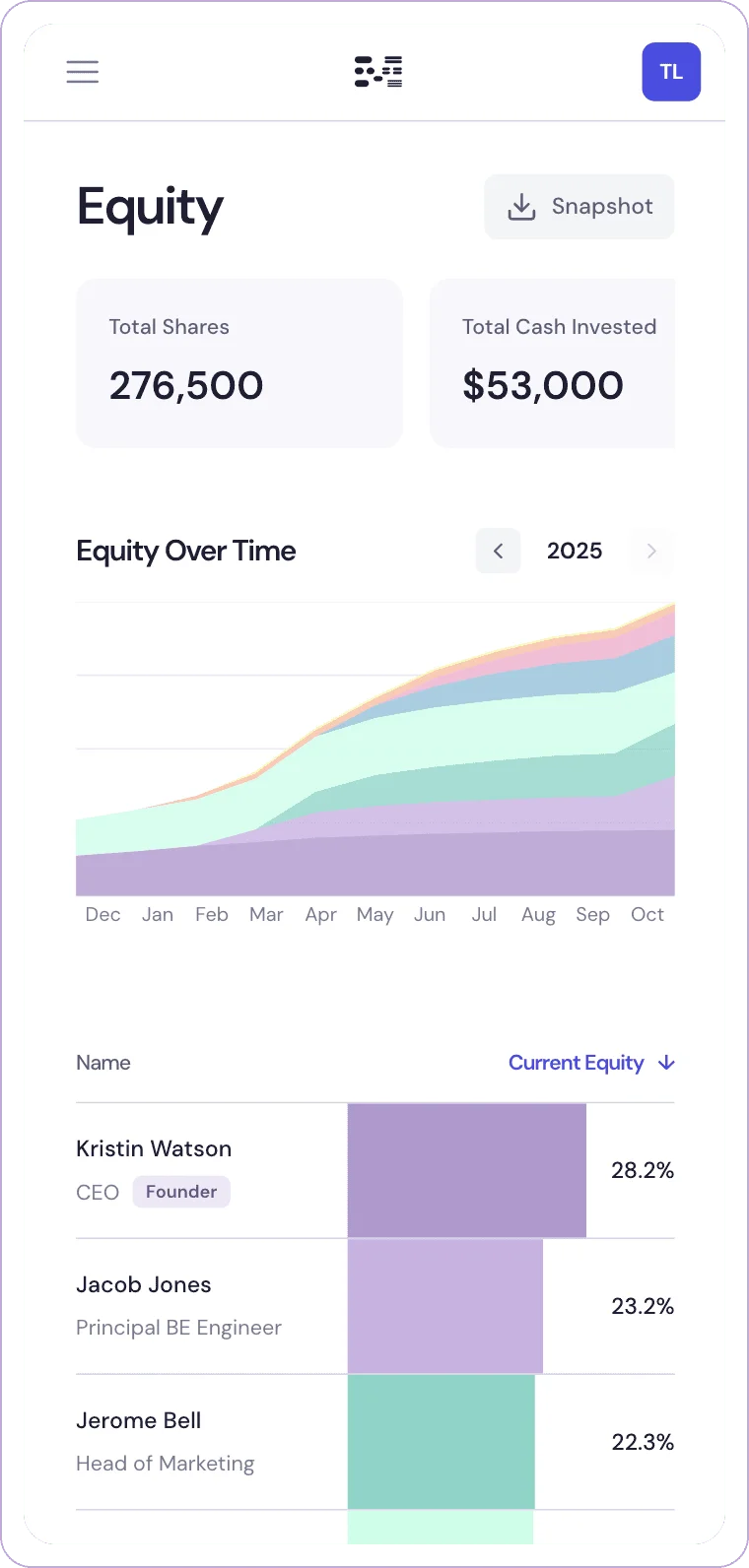
Replace Liechtenstein's defaults with a fair agreement.
Equity Matrix tracks contributions and calculates ownership automatically, so your agreement reflects what your team actually built together.