A standard advisor grant pays for time on the list, not for help. If your advisor makes ten introductions or none, the shares vest on the same schedule. Milestone vesting changes what the equity is paying for.
In my experience, founders often have one advisor who was worth every share and one who faded after the second call. Both vested the same way. That second advisor is how you end up with dead equity: ownership held by someone who isn’t contributing anymore.
This post is about the second problem. If you’re still working out how big the grant should be, start with our guide to how much equity advisors should get. It covers typical ranges, the FAST agreement, and the standard schedule. Here, we’ll assume you’ve picked a number and want the advisor to earn it.
Why time-based vesting misses for advisors
Time-based vesting works well for employees because showing up is most of the job. An employee who’s there every day for two years has almost certainly contributed.
Advisors are different. Their value tends to come in specific moments, like a pricing call or a warning about a mistake they’ve already made. An advisor can stay “active” for two years without any of those moments happening.
A lot of early companies use the FAST agreement for advisors. It vests over two years with a three-month cliff. That cliff screens out advisors who disappear right away. It doesn’t catch a pattern I’ve seen more often: an advisor who’s helpful for a quarter, then gets busy.
Time-based vesting asks “are they still around?” Milestone vesting asks “did they do what we agreed?”
Four ways to tie advisor equity to contributions
None of these is right for every advisor. I’ve found the choice depends mostly on how predictable the advisor’s help is.
Milestone vesting
Shares vest when the advisor completes defined deliverables, not on a calendar. For example, a quarter of the grant when they run a pricing workshop with your team, and another quarter when they review your first enterprise contracts.
This works best when you know exactly what you need from the advisor. It works poorly when their value is “be on call when things go sideways,” because you can’t put that on a checklist.
Hybrid: a time-based base plus milestones
A smaller slice vests over time for availability, and the larger slice vests on milestones.
This is usually where I’d start, with something like a quarter of the grant on time and the rest on deliverables. A time-based slice pays for the advisor’s attention, which has real value. A milestone slice pays for results. I’ve also found experienced advisors are more comfortable with it than with a pure checklist.
Contribution-based accrual
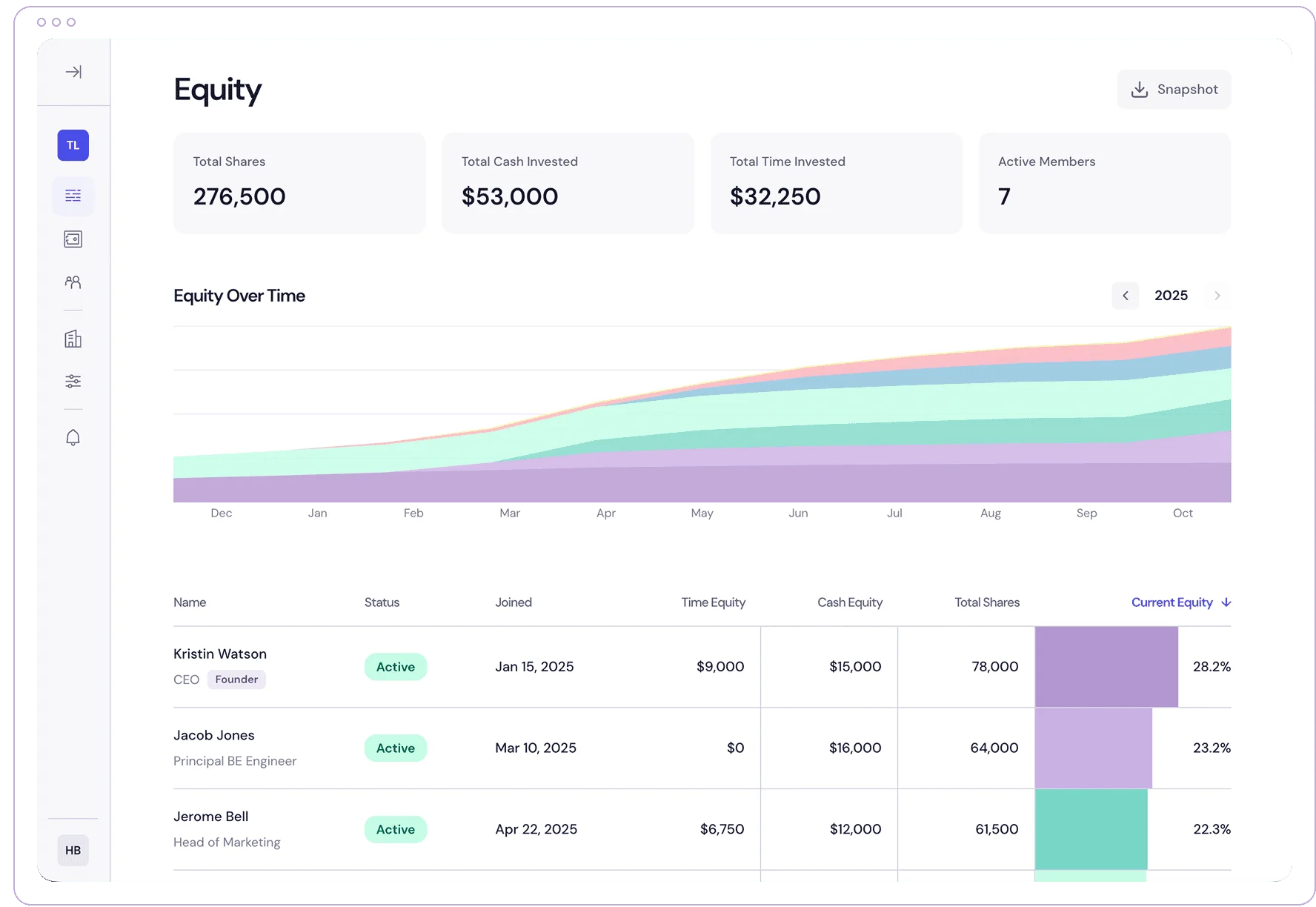
Instead of a fixed grant, the advisor earns equity as they contribute, the same way founders do in a dynamic equity model. Each hour of advice or agreed deliverable has a value, and the advisor’s share is their contributions relative to everyone else’s.
You still agree on values up front (an hourly rate, what a deliverable is worth, and a cap), but not on a final percentage. An advisor who helps a lot ends up with more. One who drifts off stops accruing, and what they hold reflects what they actually gave.
Two things to watch. When founders count their unpaid time too, an active advisor’s share can come out higher than the usual advisor ranges, so set the cap before it surprises anyone. And if equity is actually issued as it accrues, each issuance can be a separate taxable event for the advisor, so many dynamic equity setups track contributions and issue equity once, when the split is converted. Your accountant should look at how you plan to do that.
Cash for deliverables
Sometimes equity is the wrong tool. If you need one defined job done, like a security review or a single pricing project, a fee is often cleaner for everyone. If you’re weighing a mix, our post on equity for contractors and freelancers covers how to size equity offered in place of cash.
| Approach | Best for | Main risk |
|---|---|---|
| Time-based (FAST default) | Advisors whose value is ongoing availability | Shares vest whether or not they help |
| Milestone vesting | Advisors brought in for specific outcomes | Vague milestones turn into disputes |
| Hybrid | A sensible default when you’re unsure | Slightly more paperwork |
| Contribution-based accrual | Pre-funding teams already tracking contributions | Needs consistent tracking to be fair |
| Cash fee | One defined project | Uses cash you may not have |
How to write milestones that don’t cause fights
A milestone that both sides read differently can do more harm than having none. I’ve seen “help us close our seed round” mean an introduction to one advisor and a signed term sheet to the other.
Here’s what I’ve seen hold up:
- Countable outcomes. “Three introductions to regional distributors who take a first call” beats “distribution help.”
- Effort the advisor controls. Making the introduction is in their hands. Whether the distributor signs depends on you and the distributor too, and paying for outcomes the advisor can’t control tends to breed resentment on both sides.
- A named person who confirms it. Usually that’s the CEO or the board, confirming each milestone in an email so there’s a record.
- An end date. Milestones that aren’t hit within, say, 24 months expire. Without a date, an unfinished milestone can sit on your cap table for years.
- A plan for a pivot. If the company changes direction and a milestone stops mattering, agree in advance to swap it for one of similar weight rather than cancel it.
A worked example
Say you’ve decided an advisor is worth 0.5% of a company with 10,000,000 shares. That’s 50,000 shares. A hybrid structure might look like this:
| Slice | Shares | Vests when |
|---|---|---|
| Availability | 12,500 | Monthly over 12 months, 3-month cliff |
| Pricing | 12,500 | Advisor runs a pricing workshop and delivers written recommendations |
| Distribution | 12,500 | Three introductions to regional distributors who take a first call |
| Contracts | 12,500 | Advisor reviews your first three enterprise contracts before signing |
The availability slice runs for 12 months rather than FAST’s 24 because, in this structure, it’s paying for attention during the first year, when you lean on the advisor most. Milestones get the full 24 months.
If the advisor delivers everything, they earn the full 0.5%. If they clear the three-month cliff, deliver nothing, and stop showing up at month three, they keep 3,125 shares (3/12 of the availability slice) instead of 50,000. If they leave before the cliff, they keep nothing.
A milestone to avoid: paying equity for fundraising
It’s tempting to make “introduce us to investors” or “help close the round” a milestone. I’d keep fundraising out of milestones entirely.
Equity that depends on a successful raise can look like a finder’s fee, and paying someone for bringing in investors raises securities-law questions about acting as an unregistered broker. Dropping the success-based element lowers that risk but doesn’t remove it if the advisor is soliciting or negotiating with investors.
There’s a second issue. Rule 701, a common exemption for equity grants to advisors who are individuals, doesn’t cover services connected to raising capital. Even advice-only milestones like reworking your pitch deck can fall on the wrong side of that line. Anything fundraising-related is worth running past your lawyer first.
Tax and legal details to check
Milestone vesting changes some of the paperwork. These are the ones I’d raise with your lawyer and accountant:
- Restricted stock and the 83(b) election. If the advisor receives shares up front that vest on milestones, those shares are subject to forfeiture, so Section 83 applies. An 83(b) election, filed within 30 days of when the shares are transferred, lets them pay tax now on the shares’ value minus anything they paid, instead of on the value when each milestone hits. If they later forfeit unvested shares, they don’t get that tax back.
- Options instead of shares. Advisors aren’t employees, so they can’t receive ISOs. They get non-qualified stock options. Pricing those below fair market value can trigger Section 409A penalties, which is why companies usually set the exercise price using a 409A valuation.
- What happens to unvested equity. Unvested restricted shares are forfeited or repurchased by the company, according to the agreement. Unvested options simply expire. Either way, those shares can usually be granted again from the option pool.
- LLCs. In an LLC, advisor equity is often a profits interest. Revenue Procedure 2001-43 covers profits interests that haven’t vested yet, subject to conditions your accountant should confirm apply to a milestone-based grant.
- Signed paperwork. A handshake milestone tends to turn into a dispute. The milestones, who confirms them, and the expiry date belong in the signed advisor agreement.
Where tracking comes in
Milestone vesting only works if someone keeps score. In practice that’s often a founder with a spreadsheet, which works fine until there are several advisors and nobody remembers which introductions counted.
Contribution-based accrual needs even more consistent tracking, because every hour and deliverable feeds the split. That’s the same problem Equity Matrix already solves for founders: a shared record of who contributed what, and ownership that follows it.
We’re building advisor tracking on top of that, so advisors can sit in the same model as your founders, with their contributions logged and their equity calculated from them. If that’s what you need, the waitlist is below.
Frequently asked questions
What is milestone vesting for advisors?
Milestone vesting means an advisor’s shares or options vest when they complete agreed deliverables, like a pricing workshop or a set number of introductions, rather than on a monthly schedule. It ties the equity to what the advisor actually does instead of how long they stay on the list.
Can you combine time-based and milestone vesting?
Yes, and I think it’s the most practical setup for many advisors. A smaller portion vests over time to pay for availability, and the rest vests on milestones. I’d start with roughly a quarter on time and adjust from there.
Who decides whether a milestone has been met?
Name that person in the agreement, usually the CEO or the board. The milestone should be specific enough that confirming it is a formality, and the confirmation should be in writing, like an email that says the milestone is complete and on what date.
Is milestone vesting compatible with the FAST agreement?
Standard FAST agreements vest on time, not milestones. Adding milestones means a custom amendment your lawyer drafts. Our advisor equity guide covers what the standard FAST template includes.
Advisor tracking is coming to Equity Matrix.
Log what each advisor delivers and let their equity follow it, next to your founders' contributions. Join the waitlist and we'll let you know when it's ready.
This article is for informational purposes only and does not constitute legal, tax, or financial advice. Equity Matrix is not a law firm, accounting firm, or financial advisor. Consult a qualified professional for guidance specific to your situation.

Co-founder, Equity Matrix
Sebastian writes about startup equity, founder dynamics, and building fair partnerships.
Keep reading
Phantom equity and dynamic equity: how to combine them
Phantom equity is usually a fixed grant. Here's how to make it contribution-based instead, with two structures, a worked example, and the 409A and wage-law limits.
Read more →Co-founders in different countries: how to set a fair rate
When one co-founder is in the US and another is in Lithuania, do you value their time at local rates or the same rate for the same work? How to set GHRR fairly across borders.
Read more →