LLC ownership is divided into membership interests, and unlike a corporation’s rigid share structure, you can split them however you want. There’s no law that says LLC members must own equal percentages. You can do 50/50, 60/40, 70/20/10, or any other combination that reflects what each person is bringing to the table.
The problem is that most people default to equal splits because it’s simple and feels fair. Then six months later, one person is running the business full-time while the other checks in occasionally, and both still own half. That’s how partnerships blow up.
This post covers how to think about LLC ownership splits, what factors actually matter, and how to structure it so the split stays fair as the business evolves.
What LLC ownership actually means
Before splitting anything, it helps to understand what you’re dividing.
An LLC membership interest typically comes with two things:
Economic rights — your share of profits, losses, and distributions. If you own 40% of the LLC, you’re generally entitled to 40% of distributions (unless the operating agreement says otherwise).
Governance rights — your vote on major decisions. In most LLCs, voting power follows ownership percentage, but you can structure it differently. One member could own 30% of the economics but have 50% voting power if the operating agreement is drafted that way.
This flexibility is one of the reasons LLCs are popular for small businesses and partnerships. You’re not locked into the rigid share-class structure of a corporation. You can customize the arrangement to fit your situation.
Ownership vs. profit sharing
These don’t have to be the same number. An LLC operating agreement can specify that ownership is 50/50 but profits are split 60/40 to reflect different contribution levels. Or that one member receives a guaranteed payment (similar to a salary) before profits are split.
This distinction matters because many partnership disputes stem from conflating ownership percentage with profit distribution. You can address contribution imbalances through profit-sharing adjustments without touching the ownership split at all.
One important note: if you separate ownership from profit-sharing, the IRS has rules (IRC Section 704(b), “substantial economic effect”) governing whether those allocations will be respected for tax purposes. Talk to a tax advisor before setting up creative split arrangements, and make sure your bookkeeper maintains proper capital accounts for each member.
Model your LLC ownership split.
Enter each member's cash and time contributions to see what a fair split looks like.
Try the calculator →The factors that should drive your split
There’s no formula that works for every LLC. But there are factors that come up in nearly every ownership conversation.
Cash investment
The most straightforward factor. If one person puts in $100K and the other puts in $50K, the money person has a reasonable claim to a larger share. But cash alone shouldn’t determine ownership. A partner who invests $100K and disappears isn’t more valuable than a partner who invests $20K and builds the entire business.
How to weight it: cash contributions should be valued alongside other contributions, not above them. One common approach is to assign a multiplier to cash (1.5x to 4x the equivalent hours) since money carries more risk — you can lose it entirely, while time spent at least builds skills and experience. Where you land in that range depends on the risk level: a 1.5x multiplier makes sense for a well-funded business with steady revenue, while 3-4x is appropriate for an unproven venture where the cash could be lost entirely.
Time and labor
In many small businesses, one partner works full-time and the other works part-time or contributes intermittently. This is the most common source of ownership disputes. If you’re working 50 hours a week and your partner is working 10, a 50/50 split is going to breed resentment fast.
How to weight it: agree on market rates for each person’s role (what would you pay someone to do this job?), then track hours. A partner contributing 40 hours/week at a $100/hour market rate is contributing $4,000/week in sweat equity. A partner contributing 10 hours/week at $75/hour is contributing $750/week. The math tells a clear story. If you’re structuring a partnership where one person contributes cash and the other contributes labor, the guide to sweat equity in small businesses covers how to value time, handle the salary question, and protect both partners.
Skills and expertise
Not all hours are equal. A partner who brings 20 years of industry relationships and a professional license contributes differently than one who’s learning on the job. Specialized skills — a liquor license, a contractor’s license, a medical degree, a client book — can justify a larger share even with fewer hours.
How to weight it: this is the hardest factor to quantify. One approach is to ask “what would it cost to hire this skill on the open market?” A partner whose expertise would cost $200K/year to replace brings more economic value per hour than one whose role could be filled at $60K/year.
Existing assets and IP
Did one partner bring an existing business, client list, brand, equipment, or intellectual property into the LLC? This prior investment should be valued and factored into the split. A restaurant partner who contributes a fully equipped kitchen is starting from a very different position than one who contributes only their time.
Risk tolerance
Who signed the lease? Who personally guaranteed the business loan? Who quit their job to go full-time while the other kept their day job? Risk-bearing should be compensated. The partner who takes on more financial and career risk has a stronger claim to a larger ownership stake.
Common LLC ownership structures
| Structure | How it works | Best for |
|---|---|---|
| Equal split (50/50, 33/33/33) | Everyone owns the same percentage | Truly equal contributions in cash, time, and skills |
| Proportional to capital | Ownership matches cash invested | Capital-heavy businesses (real estate, manufacturing) |
| Proportional to contribution | Ownership reflects a mix of cash, time, and skills | Most active partnerships |
| Split economics from governance | Ownership percentage differs from profit split and voting power | Complex partnerships with silent or part-time members |
| Dynamic / contribution-based | Ownership adjusts over time based on tracked contributions | Partnerships where contributions are expected to change |
The problem with picking a number on day one
Every static split faces the same challenge: it’s a snapshot. You’re dividing ownership based on what you expect each person to contribute, but expectations and reality rarely match.
Six months in, one partner might be doing 80% of the work. A year in, one might have invested twice as much cash as planned. Two years in, one might have brought in the client that represents half your revenue.
A fixed split can’t account for any of that. It locks you into a ratio that was fair on day one and might be unfair by day 90.
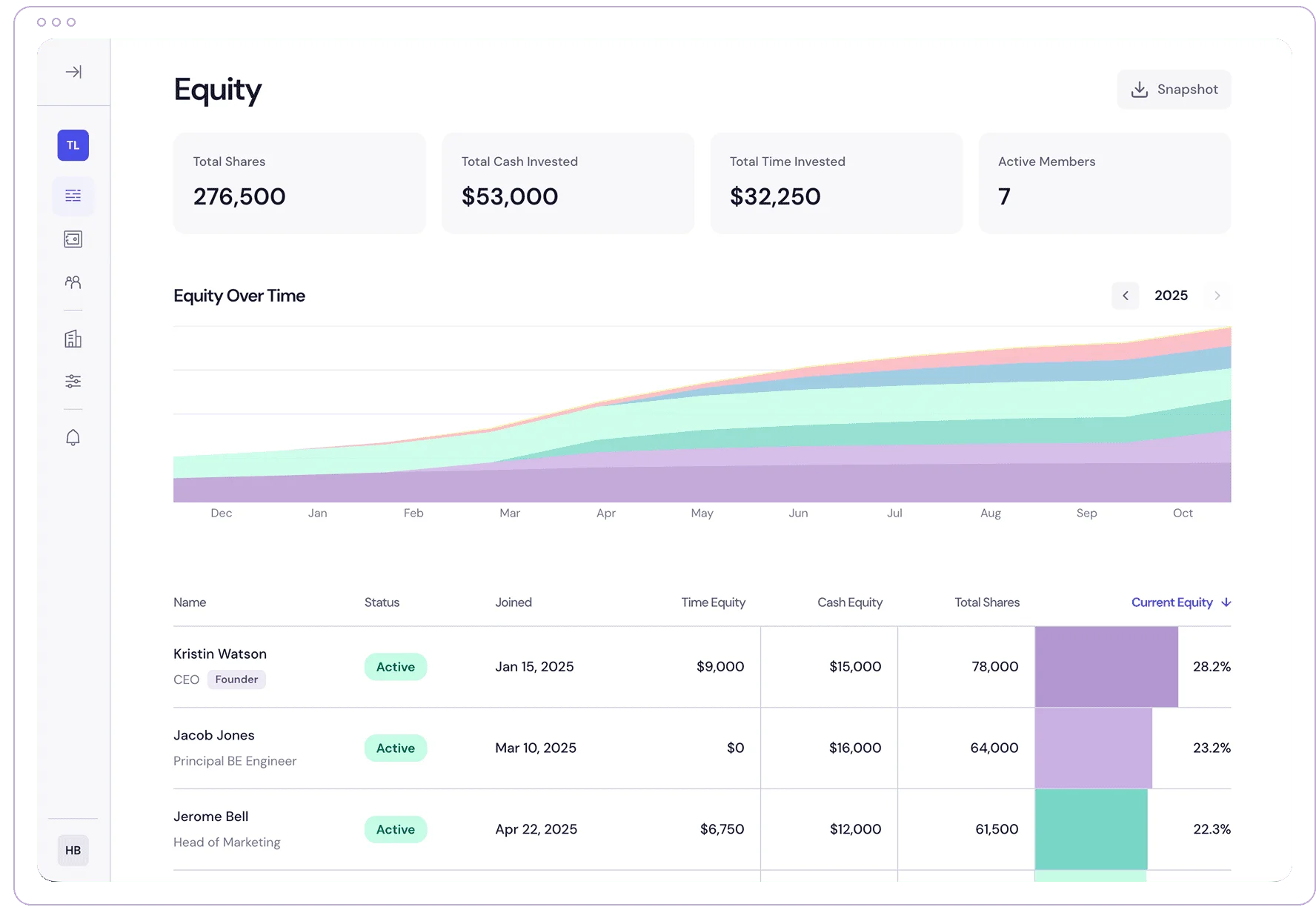
This is why more partnerships are moving toward contribution-based models where ownership reflects ongoing input rather than a one-time negotiation. You track what each person puts in — hours, cash, expertise, assets — and ownership percentages adjust proportionally. When someone’s contributions slow down, their ownership percentage naturally decreases. When they step up, it increases.
How to negotiate the split
Start with a contribution inventory
Before throwing percentages around, list what each person is bringing:
| Contribution type | Partner A | Partner B |
|---|---|---|
| Cash invested | $50,000 | $10,000 |
| Hours/week committed | 20 (part-time) | 45 (full-time) |
| Market rate for their role | $120/hr (sales) | $85/hr (operations) |
| Key assets brought in | Client relationships, industry network | Systems, process design |
| Personal guarantees signed | Business loan ($80K) | Lease co-sign |
| Opportunity cost | Keeping day job | Left $130K/year salary |
Looking at this table, a 50/50 split would clearly undervalue Partner B’s time commitment and opportunity cost, even though Partner A brings more cash and higher-value skills per hour.
Run the math multiple ways
Try weighting the factors differently and see how the split changes. The partnership fairness calculator lets you model these scenarios side by side — plug in each person’s cash, hours, and market rate for their role to see how the split shifts under different weightings before you commit to a number.
Cash-weighted: Partner A contributed 83% of the capital. If cash is all that matters, the split is roughly 80/20.
Time-weighted: Partner B works 2.25x the hours. If time is all that matters and you normalize for market rates, Partner B contributes $3,825/week vs Partner A’s $2,400/week — roughly 62/38 in Partner B’s favor.
Blended: Most realistic. Weight cash at 30%, ongoing time at 50%, and skills/assets at 20%. Run the numbers and you might land at something like 55/45 or 52/48.
The specific percentages matter less than the process. When both partners see the math, the conversation shifts from “what feels fair” to “what the data shows.”
Don’t forget ongoing vs. one-time contributions
Cash investment is a one-time event. Weekly hours are ongoing. A partner who invests $50K upfront and then contributes 10 hours/week will be overtaken in total contribution value by a partner who invests nothing but works 50 hours/week — it’s just a question of when.
Your split should account for this. Options include:
- Vesting: Ownership earned over time based on continued contribution (vesting schedules explained)
- Dynamic equity: Ownership continuously recalculated based on tracked contributions
- Guaranteed payments: The working partner receives a salary-like payment before profits are split, compensating for the time imbalance without changing ownership
What to put in your operating agreement
Whatever split you agree to, it needs to be in writing. An LLC operating agreement should specify:
- Membership interests — each member’s ownership percentage
- Capital contributions — what each member invested (cash, property, services) and how additional contributions are handled
- Profit and loss allocation — how profits and losses are divided (this can differ from ownership percentage)
- Distribution schedule — when and how profits are distributed to members
- Management structure — member-managed vs. manager-managed, voting thresholds for major decisions
- Transfer restrictions — whether and how a member can sell or transfer their interest
- Buyout provisions — what happens if a member wants to leave, dies, becomes disabled, or is removed (co-founder agreement template)
- Contribution requirements — minimum expected contributions and what happens if a member falls short
- Dissolution provisions — what triggers dissolution, how assets are liquidated, and how remaining proceeds are distributed
- Amendment process — how the agreement can be changed (usually requires unanimous or supermajority consent)
If you don’t have a written operating agreement, your state’s default LLC rules apply. Those defaults vary by state but rarely reflect what partners actually intended. Getting a written agreement is the single most important thing you can do to protect your partnership.
Special situations
One partner contributes only cash (silent partner)
This is common in real estate partnerships, restaurants, and retail. The cash partner gets an ownership stake based on their investment but doesn’t participate in daily operations.
Structure it clearly: the operating partner receives a guaranteed payment (management fee) for their work. Remaining profits are split according to ownership. The cash partner’s return comes from distributions, not labor. Include clear expectations about reporting, decision rights, and the cash partner’s ability (or inability) to interfere with operations.
Unequal time commitments
One partner works full-time, the other part-time. Instead of fighting about percentages, compensate for the difference through guaranteed payments or a contribution-based model that automatically adjusts ownership based on hours contributed. The part-time partner owns less because they contribute less. If their commitment increases later, so does their ownership.
Bringing in a new member later
Adding a new member to an existing LLC means diluting existing owners. If the LLC’s existing interests are worth $500K (pre-money) and you bring in a new member for 20%, they’d need to contribute $125K — making the total post-money value $625K, of which their $125K represents 20%. Your operating agreement should define how “worth” is determined (appraised fair market value, book value, or a formula), since the methodology can produce very different numbers. The operating agreement should define the process for admitting new members, including valuation methodology and consent requirements.
Husband and wife / family partnerships
Treat it like any other business partnership. Written agreement, defined roles, clear ownership terms. Family relationships don’t protect you from partnership disputes — they make them worse because the personal and professional stakes are tangled together. Family business disputes are among the most common reasons small businesses fail.
Frequently asked questions
Can LLC members have different ownership percentages?
Yes. There is no requirement for equal ownership in an LLC. Members can own any percentage that’s agreed upon in the operating agreement. You can have two members at 50/50, three members at 60/25/15, or any other combination. The operating agreement defines the split, and it can also specify that profit sharing differs from ownership percentage.
What if we already agreed to 50/50 and it’s not working?
You can amend the operating agreement to change the ownership split, but it requires consent from all members (unless the agreement itself specifies a different amendment process). If your partner won’t agree to a change, your options are mediation, a buyout, or dissolution. Starting to track contributions now gives you data to support the conversation about restructuring. Any ownership change should be reviewed by both a business attorney and a tax advisor, as it can trigger taxable events.
Should we split ownership based on who invested more money?
Cash should be a factor, not the only factor. A partner who invests $100K and works 5 hours a week is contributing differently than one who invests $20K and works 50 hours a week. Over time, the full-time partner’s sweat equity will exceed the cash investment in total value. Weight cash alongside time, skills, risk, and ongoing contribution for a split that stays fair as the business grows.
Do we need a lawyer to set up the ownership split?
You don’t need a lawyer to decide on the split — that’s a business conversation between partners. But you do need a lawyer to draft or review the operating agreement that codifies it. A poorly drafted agreement (or no agreement at all) is the number one reason partnership disputes become expensive legal battles. The cost of a business attorney drafting an operating agreement ($1,500-$5,000) is trivial compared to the cost of litigating a dispute without one.
Ready to move beyond handshake agreements? Start tracking contributions with Equity Matrix so your LLC ownership always reflects who’s actually building the business.
Ready to split equity fairly?
Equity Matrix tracks contributions and calculates ownership automatically.
Get Started FreeThis article is for informational purposes only and does not constitute legal, tax, or financial advice. Equity Matrix is not a law firm, accounting firm, or financial advisor. Consult a qualified professional for guidance specific to your situation.

Co-founder, Equity Matrix
Sebastian writes about startup equity, founder dynamics, and building fair partnerships.
Keep reading
Co-founders in different countries: how to set a fair rate
When one co-founder is in the US and another is in Lithuania, do you value their time at local rates or the same rate for the same work? How to set GHRR fairly across borders.
Read more →How to track co-founder contributions (before it costs you)
A practical system for tracking co-founder contributions: what to log, how often, the fields that matter, and where spreadsheets start to strain.
Read more →