In an LLC, profits don’t have to follow ownership percentages. A partner who owns 40% of the company can receive 60% of the profits. A partner who invested cash can get paid back first before anyone else sees a dollar. You can structure it however you want, as long as it’s in the operating agreement and it satisfies the IRS.
They assume that if two people own 50/50, they split profits 50/50. And in the simplest case, that’s fine. But the moment contributions become unequal (one person works full-time, the other invests cash; one brings clients, the other manages operations), the default equal split starts creating resentment.
Our research found that the gap between what partners contribute and what they receive is the root cause of most equity disputes. Profit sharing is where that gap shows up in people’s bank accounts.
Ownership vs. profit sharing: they’re not the same thing
This is the concept most LLC owners miss. In a typical corporation with one class of stock, if you own 30% of the shares, you get 30% of the dividends. But an LLC is more flexible.
Ownership percentage determines who owns the company, who has governance rights, and who gets what if the company is sold or dissolved. It’s the long-term value.
Profit distribution determines who gets paid from the company’s ongoing earnings. It’s the short-term cash flow.
You can separate these. A partner who owns 50% might receive 70% of profits because they’re doing all the work. A partner who invested the startup capital might own 40% but receive a preferred return on their investment before profits are split. A partner who brings in clients might receive a commission-like profit share on the revenue they generate, in addition to their ownership stake.
This flexibility is one of the main reasons to choose an LLC over a corporation.
The default rule (and why it usually doesn’t work)
If your operating agreement doesn’t specify how profits are distributed, most states default to one of two rules:
- Equal split regardless of ownership percentage (common under the Revised Uniform LLC Act)
- Split by capital contribution (some states)
Both defaults are problematic when contributions are unequal. Equal splitting ignores differences in effort. Capital-based splitting ignores the value of labor. Neither reflects reality for most partnerships.
The state’s default rule is a blunt instrument applied to a nuanced relationship. It doesn’t know who’s working 60 hours and who’s checking in once a month.
So write it into your operating agreement before reality forces the conversation. There are a few models that tend to work well.
Model 1: Pro-rata (profits follow ownership)
The simplest approach. If you own 60%, you get 60% of the profits.
When it works: When ownership percentages already reflect each partner’s contributions fairly. If both partners are full-time, contributing equally, and the ownership split was intentionally negotiated, then tying profits to ownership makes sense. One number governs everything.
When it breaks: When someone’s ongoing contributions don’t match their ownership stake. A partner who invested cash for 40% ownership but doesn’t work in the business is receiving 40% of the profits generated entirely by the other partner’s labor. Over time, this breeds resentment. It’s one of the patterns we saw repeatedly in our equity split research.
Model 2: Guaranteed payments + profit split
Pay active partners a guaranteed payment for their work first, then split remaining profits by ownership percentage. (In LLC terms, these are “guaranteed payments” under IRC Section 707(c), not W-2 salaries. LLC members can’t be on their own payroll unless the LLC has elected S-corp or C-corp taxation.)
How it works:
- Determine a fair market salary for each active partner’s role
- Pay those salaries as guaranteed payments (these are business expenses, deductible by the LLC)
- Distribute remaining profits according to ownership percentages
Example: Two partners own 50/50. Partner A manages operations full-time (market salary: $90,000). Partner B invested capital but works part-time on strategy (market salary: $30,000). The business generates $200,000 in profit.
- Partner A receives: $90,000 salary + 50% of remaining $80,000 = $130,000
- Partner B receives: $30,000 salary + 50% of remaining $80,000 = $70,000
They still own equal shares of the company, but the person doing more work takes home more money. That’s the point.
Tax note: Guaranteed payments to LLC members are taxed as ordinary income and are subject to self-employment tax. They’re deducted from partnership income before computing each partner’s distributive share. Your CPA should be involved in structuring these.
Model 3: Preferred return + residual split
Give the capital-investing partner a priority return on their investment before splitting remaining profits.
How it works:
- The investing partner receives a preferred return (typically 6-10% annually) on their capital contribution
- After the preferred return is paid, remaining profits are split according to an agreed-upon ratio
Example: Partner A invested $200,000. Partner B invests time running the business. Preferred return is 8%.
- Partner A gets their $16,000 preferred return first (8% of $200K)
- Remaining profits split 40/60 (A/B) to reflect that B is doing the daily work
- If the business earns $100,000: A gets $16,000 + 40% of $84,000 = $49,600. B gets 60% of $84,000 = $50,400
This model is common in real estate partnerships and any business where one partner brings capital and the other brings sweat equity.
Model 4: Contribution-based (dynamic)
Profit shares adjust based on what each partner actually contributes each period.
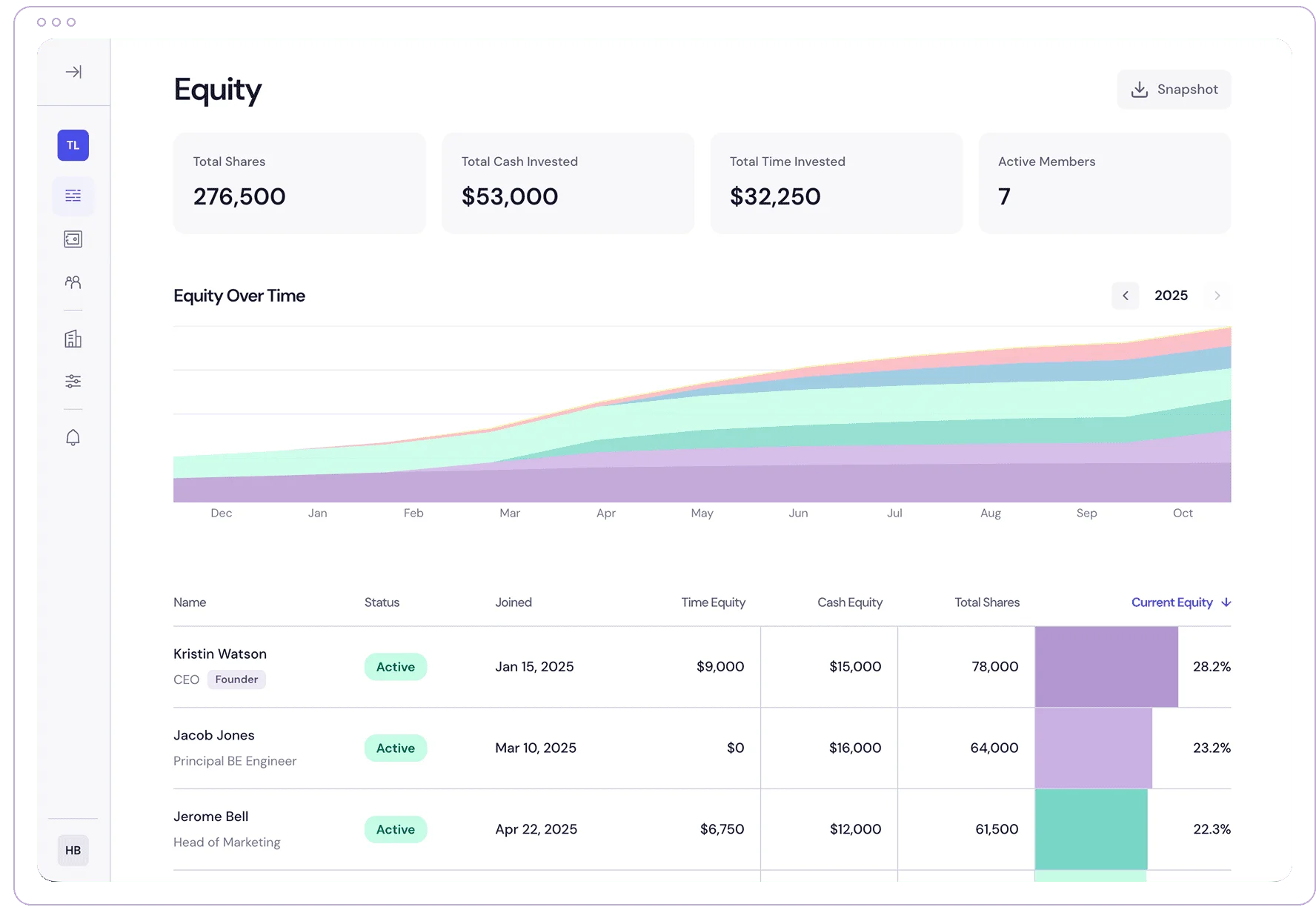
How it works: Track each partner’s contributions (hours, cash, clients brought in, revenue generated) and distribute profits proportionally based on tracked contributions. This is dynamic equity applied to profit distribution rather than ownership.
Example: Two partners in a consulting firm. This quarter, Partner A billed 400 hours and Partner B billed 250 hours. Profits are split 62/38 based on hours. Next quarter, the ratio might shift.
When it works: Service businesses, agencies, consulting firms, and any partnership where the value each person generates is measurable. It eliminates the “I’m doing all the work” argument because the data speaks for itself.
How to track it: Use the equity calculator to log contributions and compute shares automatically, or maintain a shared spreadsheet that both partners update weekly.
The hybrid model (and why most LLCs land here)
Combine elements from the models above. Most real partnerships don’t fit neatly into one model.
A common hybrid structure:
- Guaranteed payments for active partners (compensates daily labor)
- Preferred return for the capital partner (compensates investment risk)
- Residual profits split by a negotiated ratio that may differ from ownership
This separates three types of value: labor, capital, and ownership. Each gets compensated through its own mechanism. Nobody’s work subsidizes someone else’s return, and nobody’s investment goes uncompensated.
Example operating agreement language:
“Profits shall be distributed as follows: First, guaranteed payments of $X per year to Member A and $Y per year to Member B for services rendered. Second, a preferred return of 8% per annum on unreturned capital contributions to each member. Third, remaining distributable cash shall be allocated 55% to Member A and 45% to Member B.”
Special allocations and the IRS
Here’s where it gets technical. If your profit allocations differ from your ownership percentages, the IRS calls these “special allocations” and they must comply with IRC Section 704(b).
The rule: allocations must have substantial economic effect. This is a two-part test:
- Economic effect: The allocation must actually change the dollar amount each partner receives. It can’t be a paper exercise that only shifts tax liability.
- Substantiality: The allocation must have a meaningful impact independent of tax consequences. You can’t create allocations that only exist to shift income to a lower-tax partner.
What this means in practice:
- Your operating agreement must maintain capital accounts for each member
- Liquidating distributions must follow capital account balances
- Partners with negative capital accounts must restore them on liquidation (or qualify for an alternative test)
- Allocations must reflect the genuine economic arrangement, not just tax optimization
If your allocations fail the substantial economic effect test, the IRS can reallocate income based on what it considers the partners’ actual economic interests. This can create unexpected tax bills.
Bottom line: If your profit split differs from your ownership split, have a CPA review the operating agreement to ensure the allocations comply with 704(b). This is not optional for LLCs with special allocations.
When and how to distribute profits
Deciding the split is half the equation. The other half is the mechanics: when do partners actually get paid?
Distribution frequency
Common approaches:
- Monthly: Best for partners who depend on LLC income as their primary compensation
- Quarterly: Most common for established businesses with predictable cash flow
- Annually: Works for businesses with seasonal revenue or irregular income
- As-needed: Flexible but can cause friction if partners disagree on timing
Whatever you choose, put it in the operating agreement with specific dates or triggers.
Retained earnings
Not all profits should be distributed. The business needs cash reserves for operations, growth, and unexpected expenses. Define in your operating agreement what percentage of profits is retained vs. distributed. A common split: retain 20-30% for the business, distribute the rest.
Tax distributions
Even if you retain profits in the business, LLC members owe income tax on their share of partnership income (whether or not they receive a distribution). Smart operating agreements include a mandatory tax distribution clause: the LLC distributes enough cash to each member to cover their tax liability, even if other distributions are deferred.
How to handle changes over time
Partnerships evolve. The partner who was full-time last year might go part-time. New capital might be invested. Revenue sources shift. Your profit-sharing model needs to accommodate this.
Regular reviews
Schedule annual or quarterly reviews of the profit distribution arrangement. Use a framework like the equity review matrix to structure the conversation. Are contributions still roughly in line with the profit split? Does anything need adjusting?
Adjustment triggers
Define in the operating agreement what triggers a profit-sharing adjustment:
- A partner’s role or time commitment changes materially
- A new capital contribution is made
- Revenue exceeds or falls below a threshold
- A new partner is added to the business
Dynamic tracking
If your partnership involves fluctuating contributions, consider dynamic equity or contribution tracking from the start. Instead of negotiating changes after the fact, let the data determine the split. The equity calculator automates this for both ownership and profit distribution.
Frequently asked questions
Can LLC members receive different profit shares than their ownership percentages?
Yes. LLCs have full flexibility to allocate profits differently from ownership. A partner with 30% ownership can receive 50% of profits if the operating agreement specifies this. The allocation must comply with IRS Section 704(b) substantial economic effect rules, which means it must reflect a genuine economic arrangement, not just a tax strategy.
How are LLC profit distributions taxed?
LLC members pay income tax on their share of partnership income regardless of whether profits are actually distributed. Distributions themselves are generally not taxable to the extent they don’t exceed your basis in the LLC (they’re treated as returns of already-taxed income; distributions exceeding basis are taxable as capital gain). Members report their share on Schedule K-1. Active members generally pay self-employment tax on their distributive share, though the SE tax treatment of passive or limited members is more nuanced and may not apply. Guaranteed payments are also subject to self-employment tax and are deducted from partnership income before computing distributable shares. Consult your CPA for your specific situation.
What if we didn’t put profit sharing in our operating agreement?
Your state’s default rules apply, which typically means equal distribution regardless of ownership percentage or contribution level. You can amend the operating agreement at any time with the consent of all members. Do it now rather than waiting for a dispute.
How often should we review our profit-sharing arrangement?
At minimum, annually. Quarterly is better if contributions fluctuate. Any time a partner’s role, time commitment, or capital investment changes materially, that’s a trigger to revisit the arrangement. The review doesn’t have to be adversarial. Frame it as a business check-in: “Is our financial arrangement still fair given what each of us is doing?”
Most profit-sharing disputes come down to the same thing: nothing was written down, and both partners assumed different things. Pick a model, put it in the operating agreement, and revisit it once a year. The equity calculator can help you model different distribution scenarios before you commit.
Ready to split equity fairly?
Equity Matrix tracks contributions and calculates ownership automatically.
Get Started FreeThis article is for informational purposes only and does not constitute legal, tax, or financial advice. Equity Matrix is not a law firm, accounting firm, or financial advisor. Consult a qualified professional for guidance specific to your situation.

Co-founder, Equity Matrix
Sebastian writes about startup equity, founder dynamics, and building fair partnerships.
Keep reading
Co-founders in different countries: how to set a fair rate
When one co-founder is in the US and another is in Lithuania, do you value their time at local rates or the same rate for the same work? How to set GHRR fairly across borders.
Read more →How to track co-founder contributions (before it costs you)
A practical system for tracking co-founder contributions: what to log, how often, the fields that matter, and where spreadsheets start to strain.
Read more →