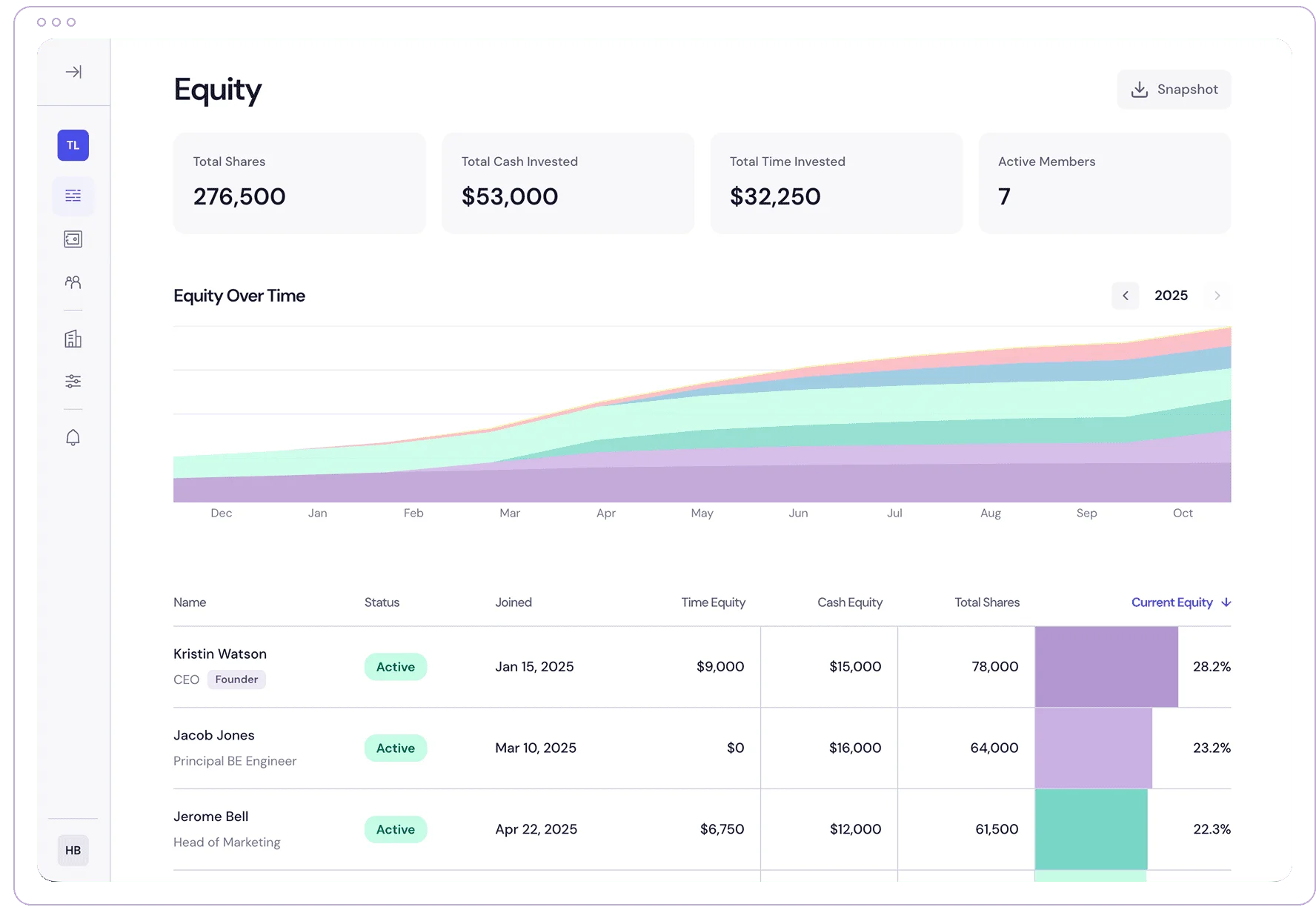
Most equity problems don’t show up as emergencies. They pile up as small loose ends: a grant nobody approved, a contribution log that stopped in July, a 409A that quietly expired. Then a fundraise, a departure, or tax season pulls on one of them and the whole thing unravels at the worst possible time.
Q4 is a good time to tie them off. There’s still room to act before December 31, and the January and March deadlines are close enough to plan for without panicking.
Here’s the checklist I’d run through. Not all of it will apply to you. Skip what doesn’t.
Close out the year’s contribution log
If you track contributions, whether in Slicing Pie, a lighter model, or a spreadsheet, the end of the year is a natural checkpoint.
Logs tend to drift in the fall. Everyone was diligent in the spring, then the weekly review slipped to biweekly, then to “we’ll catch up.” Reconstructing three months from memory is exactly how tracking turns into an argument.
So, before the holidays:
- Fill the gaps while people still remember. October is recoverable. February isn’t.
- Review entries together. A quick session where everyone looks at the full year catches the “wait, that’s not right” items while they’re small.
- Check the inputs still hold. A year is a reasonable interval to ask whether each person’s market rate still reflects their role. If someone has grown from a mid-level to a senior role, that’s worth discussing. Agree on any change going forward rather than rewriting the past.
- Snapshot the split. Save a dated record of where ownership stood at year end. It’s useful context for every conversation that follows.
If you’re running dynamic equity in an LLC, your accountant may also need this data. How profit and loss get allocated depends on your operating agreement, and a clean year-end log makes that conversation much easier. Our post on why LLCs work well for dynamic equity covers the structure.
Look for dead equity before it gets older
Dead equity is ownership held by someone who no longer contributes. It’s easiest to deal with soon after someone steps back and harder every month after.
Ask the uncomfortable question: is everyone on the cap table still doing what their stake assumed? If a co-founder has drifted, or an advisor hasn’t shown up since spring, year end is a natural, low-drama moment to raise it.
Also check your paperwork. Many stock purchase agreements give the company a right to repurchase unvested shares when someone leaves, and that right often has a deadline. If someone left this year, find out whether your window is still open. The dead equity calculator can put a number on what doing nothing costs.
Check your 409A date
If you grant stock options, your 409A valuation is what supports the fair market value you set strike prices against. Its safe harbor protection generally lasts 12 months, or until something material changes the company’s value, like a priced round.
Look at the date on your current report. If it turns 12 months old in Q1, and you’re planning to hire and grant options early next year, start the new valuation now. Waiting means either delaying grants or granting on a stale valuation. If a grant turns out to be priced below fair market value, the 409A penalties land on your employees.
If you raised this year, ask your valuation provider whether the round counts as a material event. A priced round often does, and a 409A from before the round may not support new grants.
Make sure every grant has paperwork behind it
Grants made this year should each have an approval behind them (usually the board, sometimes a committee it delegated to), a signed grant agreement, and a matching line on the cap table. In my experience, one of those goes missing more often than you’d expect, especially for grants promised in an offer letter.
Missing approvals are fixable, but the fix is easier now than in the middle of due diligence, when an investor’s lawyer is asking for the same document. The cap table management guide has a fuller list of what should line up.
One timing note for December grants. If anyone receives restricted stock that’s subject to vesting, the 83(b) election deadline is 30 days from the date the stock is transferred. It doesn’t wait for year end or tax season, and it doesn’t pause for the holidays. Those are 30 calendar days, so a grant on December 20 needs its election filed by January 19.
Plan ISO exercises before December 31
This one is for employees and founders holding incentive stock options, and it’s one of the few items here where December 31 is a hard line.
Exercising ISOs can trigger the alternative minimum tax on the spread between the strike price and current fair market value. AMT is calculated per calendar year, so an exercise on December 30 and one on January 2 land in different tax years and get tested separately.
That makes Q4 the time to model it. A few things I’d look at:
- Splitting exercises across years. If one large exercise would push you into AMT, two smaller ones in December and January sometimes don’t.
- What a same-year sale does. Selling ISO shares in the same calendar year you exercised them is a disqualifying disposition. It generally removes the AMT adjustment for those shares, but the spread (or your actual gain, if that’s smaller) becomes ordinary income instead, so your total tax can go up rather than down.
- Your rough exposure. The ISO calculator gives a ballpark estimate before you decide anything.
- A tax professional, before you exercise. Your real number depends on your whole return, and this is advice worth paying for.
If you’re the company, ISO exercises during the year mean Form 3921 filings. The usual deadlines are January 31 for the employee copy, February 28 for the IRS copy on paper, and March 31 if you file electronically. When a deadline lands on a weekend it moves to the next business day, which it does for 2026 exercises: February 1 and March 1, 2027 (IRS general instructions). Companies filing ten or more information returns in total generally have to file electronically. Most cap table tools can generate these forms, but only if the exercise data is in there.
Get ahead of Delaware franchise tax
If you’re a Delaware corporation, your annual franchise tax and annual report are due March 1. The state’s default calculation uses the authorized shares method, which for a startup with millions of authorized shares can produce a bill that looks alarming.
Many startups owe far less by recalculating under the assumed par value capital method, which uses your gross assets along with your issued and authorized shares. Founders who don’t know this sometimes panic or simply overpay. Pull your year-end share counts and total assets from your balance sheet now, and the March filing gets much less painful.
LLCs formed or registered in Delaware work differently. They don’t file the corporate annual report. Instead they pay a flat annual tax due June 1, which is easy to forget because nothing about it scales with the business.
Reconcile the cap table with reality
Last item, and the one that ties the rest together. Put your cap table next to your legal records and check that they agree:
| Check | What to compare |
|---|---|
| Share counts | Cap table against stock certificates or ledger entries |
| Option grants | Cap table against board consents and signed grant agreements |
| Exercises | Cap table against exercise notices and payments received |
| Departures | Vested and unvested shares handled per each agreement |
| SAFEs and notes | Every signed instrument listed with its correct terms |
| Option pool | Granted plus available equals the board-approved pool |
If you’re raising next year, also build a pro forma cap table for the round you have in mind. It’s much easier to model from a cap table you’ve just reconciled.
A note on what this list can’t do
A checklist catches what’s broken. It doesn’t fix a founder split that stopped reflecting reality a year ago. If the year-end review turns up a gap between who owns what and who built what, that’s a conversation worth having in January rather than in the middle of your next raise. Tracking contributions continuously is the most reliable way I’ve found to keep that conversation small, and it’s what Equity Matrix is built to do.
Frequently asked questions
When should founders do a year-end equity review? October or November works well. It leaves time to act before December 31 on anything tied to the tax year, like ISO exercises, and time to prepare for the early-2027 Form 3921 and Delaware deadlines without rushing.
Do I need a new 409A every year? If you’re granting options, generally yes. A 409A’s safe harbor typically covers up to 12 months, and a material event like a priced round can make it stale sooner. If you’re not granting options, you may not need one at all.
Is the 83(b) deadline tied to the end of the year? No. The deadline is 30 days from the date restricted stock is transferred to you, whenever that happens. December grants are risky only because the 30 days overlap the holidays.
Why is my Delaware franchise tax bill so high? Delaware’s default calculation uses the authorized shares method, which can produce a very large number for startups with millions of authorized shares. Recalculating under the assumed par value capital method often brings it down substantially. Check with your accountant or registered agent.
Should we update contribution rates at year end? Year end is a reasonable time to review them, especially if someone’s role has grown. Agree on any change going forward and record why, rather than changing past entries.
Ready to split equity fairly?
Equity Matrix tracks contributions and calculates ownership automatically.
Get Started FreeThis article is for informational purposes only and does not constitute legal, tax, or financial advice. Equity Matrix is not a law firm, accounting firm, or financial advisor. Consult a qualified professional for guidance specific to your situation.

Co-founder, Equity Matrix
Sebastian writes about startup equity, founder dynamics, and building fair partnerships.
Keep reading
Types of startup equity: options, RSUs, and more
A complete comparison of equity types including ISOs, NSOs, RSAs, RSUs, LLC membership units, and share classes. Understand tax implications, pros, cons, and when to use each.
Read more →83(b) elections explained: save thousands on taxes
The 83(b) election lets you pay taxes now on equity worth little, avoiding massive tax bills later. Here's exactly what it is, when to file, and why it matters.
Read more →